The Stanzas of the Old English Rune Poem is a monumental achievement. It raises the bar on runic studies among Heathens by a vast margin. I recommend it to anyone who has any interest whatsoever in the pre-Christian traditions of Europe. …



|
|
||
|
28 Jul 2012 The Stanzas of the Old English Rune Poem is a monumental achievement. It raises the bar on runic studies among Heathens by a vast margin. I recommend it to anyone who has any interest whatsoever in the pre-Christian traditions of Europe. … 19 May 2011
2010, Three Hands Press, 152 pages Review by ND The late Andrew Chumbley, whose arcane yet wizened style caused a stir when his … 21 Dec 2010 The magic for me lay in the descriptions of Asgard. Every time I read a chapter devoted to the characters there I had to lie down and take a nap and dream. I found the book to be a terrible inconvenience at work where I am allowed to read but sleeping is seriously frowned upon! The dreams were amazing and while I read the book I felt as though I were living in two worlds. My life in Asgard was as real as my life here. … 25 Apr 2010 Welsh Witches and Wizards is the first book to appear, in a series of four, focusing on the witchcraft of four regions of the British Isles. Well-researched and drawing mainly on documentary evidence, this initial treatise on the Welsh lore and practice of cunning-folk is carefully hewn into 8 concise chapters. … 13 Apr 2010 This book is unlike most compendiums of folktales for two reasons: firstly, the relative obscurity (in the English language at any rate) of the subject matter; and secondly, the unique and fascinating reflective threads with which the stories on offer are bound together. … 6 Apr 2010 I’ve always pined for the Dark Ages of Northern Europe, and never been able to justify it – let’s face it, the “barbarian” tribes have been brought into thorough disrepute by the dour Roman commentators of the late Empire. What a pleasure, then, to discover a book that dismantles those jaded opinions with wit and clarity. … 13 Mar 2010 I have enjoyed what I have read of Galina Krasskova’s writings, so I was quite excited to review this book. Having devoured it, I have come to the conclusion that, although there are some discordant notes that did not sit comfortably with me, it is on the whole a valuable contribution to contemporary runic lore. … 13 Mar 2010 It is no secret that the modern Heathen revival has tended to be very Aesir-centric; even the term Asatru refers specifically to Odin, Thor, and their ilk, to the exclusion of their sibling family of gods, the Vanir. … 13 Mar 2010 Open The Poetic Edda at a random page – particularly Lee Hollander’s canonical and nigh-unreadable translation – and you might find Norse mythology to be altogether too bizarre and cryptic to connect with. Such a reaction would be very understandable – Icelandic poetry is insanely complex and the stories seem to have been composed for an audience that already knew the background to the situations and characters. How, then, can we moderns find our way in? How can we translate the connection in our hearts into a form that permits speech and words? … 11 Mar 2010 This book is essential reading for anyone interested in runes or indeed European cultural history. Macleod and Mees decline to adopt the recent fashion in academic circles for dismissing the idea that the runes had any kind of magical significance, just as they refuse to pretend that different regions were hermetically sealed from one another. They steer a balanced path between emphasising the many mundane applications of the runes and their magical function, and indeed the book focuses on the latter, as may be inferred from the title. … 28 Sep 2009 My first encounter with Joscelyn Godwin’s work occurred about 10 years ago while leafing through an issue of the journal Rûna. Godwin’s article, “Polar and Solar Symbolism”, profoundly opened me to an esoteric school of thought that captivates my mind to this very day. Since then, I have read a handful of his other works, including the truly astounding Arktos which provided a foundation for further philosophical and spiritual inquiry. Henceforth, it continues with his latest book, The Golden Thread. For those who are unfamiliar with Godwin, this latest offering is as good a place to start as any. In fact, it may be his most accessible work to date. … 21 Sep 2007 The poem known to us today as Beowulf has been something of an enigma since it first began to receive serious scholarly attention almost two hundred years ago. That it survived into the modern era at all is nothing short of miraculous, but many of the allusions contained within the text would seem to suggest that it is the sole surviving component of a much larger tradition. … |
 |
|
|
Powered by WordPress & Atahualpa |
||

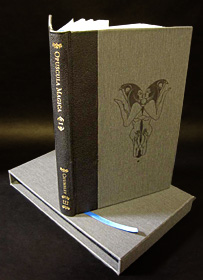 Opuscula Magica Volume I: Essays on Witchcraft and Sabbatic Tradition by Andrew D. Chumbley